In the first article of my Money That Thinks series, I argued that commercial variable recurring payments (cVRP) is really about recognising returning customers. In the second, I argued that stablecoins are just another rail, and that the hard problems in agentic payments are authority and liability. Both stayed close to what's happening right now and in the near future, whereas this final piece looks ten years ahead at what payments will look like around 2036.
My starting point is that almost every payment today assumes the payer either approves it at the time or has already decided in advance who gets paid and roughly how much, as with Direct Debit, card on file, and cVRP. Agentic payments will hand that decision to an agent, and I think most of what will change over the next decade will follow from it. It helps to separate agentic commerce from agentic payments. Agentic commerce is the discovery and the decision to buy, which agents can already do a good deal of today. Agentic payments are the last step, the payment that settles that decision, and until an agent can make it, the loop stays open and the person still has to come back to approve it. By the mid-2030s, I still expect checkout to exist, because purchase behaviour and confidence with technology will vary widely across generations, and plenty of people will still want to click a button themselves to initiate a payment. What will change is the share of payments made without the payer there, starting with routine and repeat purchases, where paying will turn into something you check after the fact.
This article looks at how we might get there, what will take the place of the account when agents do the paying, and how agents will be identified. It then turns to fraud when the agent is the one being deceived, what selling to agents will mean for merchants, and the two ways I think this could end.
How agentic payments will develop over the next decade
UK payments tend to change on something close to a ten-year cycle. Faster Payments launched in 2008 and took most of the following decade to become the default way to send money, and then open banking took from the Competition and Markets Authority's order in 2017 until 2026 to become a commercial scheme for cVRP, run by the UK Payments Initiative (UKPI).
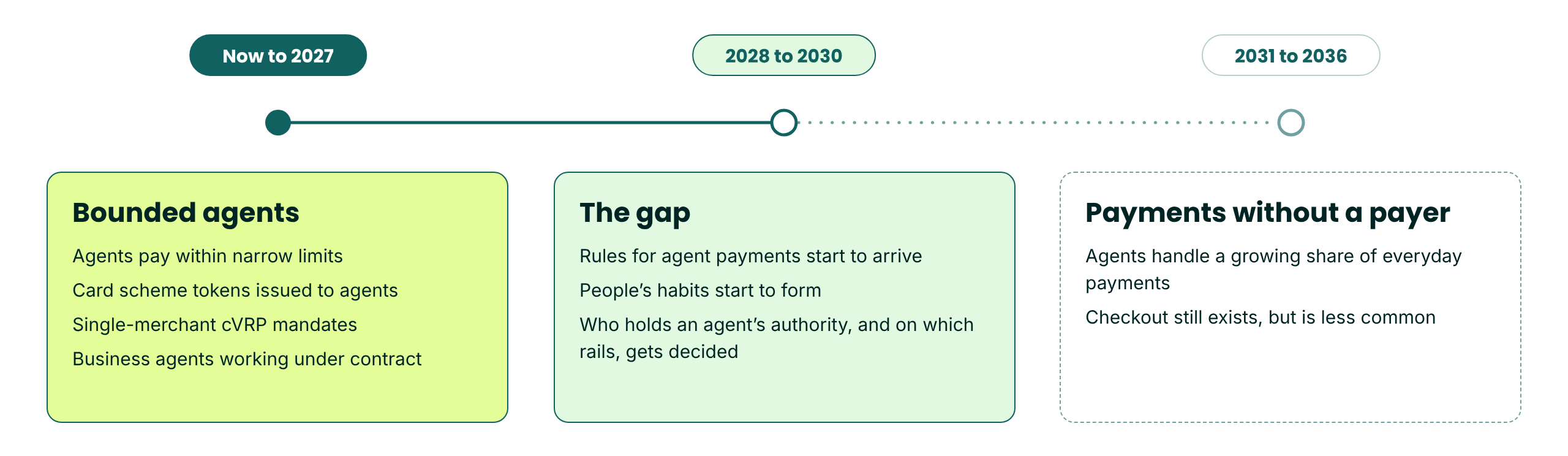
Technology moves far faster now than it did in 2008. Card schemes went from announcing agent payments in April 2025 to publishing a way to verify agents by that October. The rules, scheme sign-offs, and habits that payments depend on haven't sped up to match, though, and since they're what really sets the pace, I'm still using the ten-year cadence as my measure, which splits the next ten years into three distinct stages:
Now to 2027: bounded agents. Agents pay within narrow limits: card scheme tokens issued to agents, single-merchant cVRP mandates, and business agents working under contracts that say who pays when something goes wrong.
2028 to 2030: the gap. Rules for agent payments will start to arrive just as people's habits are forming, and this is when it will be decided who holds an agent's authority, and on which rails.
2031 to 2036: payments without a payer. Agents will handle a growing share of everyday payments alongside checkout, and the rest of this piece describes what I think that will look like.
From managing your money to managing your agents
Today, your relationship with whoever holds your money (or other assets) is your account, whether that's a bank, a neobank, an e-money wallet, or, increasingly, a digital asset wallet. You check the balance, see what's gone out, and now and then move money around manually.
In ten years' time, the thing you actually manage will more likely be a set of mandates and permissions that tell your agents what they can buy, from whom, up to what amount, and for how long. Your account will still hold the money, but you'll rarely look at it, and you'll spend far more of your time looking at what your agents are allowed to do, and what they did.
If that's right, it will change what a good payments product looks like. Setting a mandate needs to be as simple as setting a budget, and cancelling one needs to take a single tap, because while cancelling a subscription today can mean hunting through settings or calling a helpline, revoking an agent's authority can't work like that.
All of this rests on the assumption that the providers that hold people's money will end up competing on how well they manage mandates rather than on their accounts. The provider that makes it easiest to see, set, and revoke what your agents can do would then win the customer, in the same way neobanks won customers from traditional banks with better apps and features the incumbents didn't offer, such as instant spending notifications, budgeting tools and cheaper spending abroad, in the 2010s.
If that happens, holding people's money will start to look like a commodity, and the part worth competing for will be holding authority. In my previous article, I argued that if a bank-held mandate can't express what an agent needs, that authority will be recorded somewhere else, and competing on mandates is how the providers that hold people's money, whether they're banks or not, could keep hold of it. I come back to what's at stake in the final section.
Know your agent will become as essential as know your customer
Today, a regulated business runs know your customer (KYC) checks on its own customers, confirming who they are when the relationship starts, and in some cases, such as certain one-off payments, the checks are lighter or don't apply at all. Agentic payments already have an equivalent in know your agent (KYA), which the card schemes are starting to require of agents that pay, although each scheme and platform still runs its own version. Within ten years, my guess is that KYA will reach further than KYC: rather than being checked once, when someone becomes a customer, it will apply to every payment an agent makes, and will cover a good deal more than who built the agent.
Where know your agent stands today
You can see the early versions in the card schemes today. Mastercard Agent Pay requires AI agents to be registered and verified before they can pay on someone's behalf, and Visa's Trusted Agent Protocol lets merchants check cryptographically that an agent is one Visa has approved, though both are card scheme rules rather than regulation. In the UK, the government's Payments Forward Plan only commits to considering whether regulation needs to change for agentic AI payments. As far as I can tell, a business that runs an agent paying on someone's behalf doesn't yet fall into any regulatory category of its own.
From a single check to a full compliance stack
At the moment, KYA mostly answers whether the agent is known or verified. By the mid-2030s, I expect it to be one layer of a full compliance stack that mirrors the one we already have for people and businesses, recognised by whoever holds the payer's money.
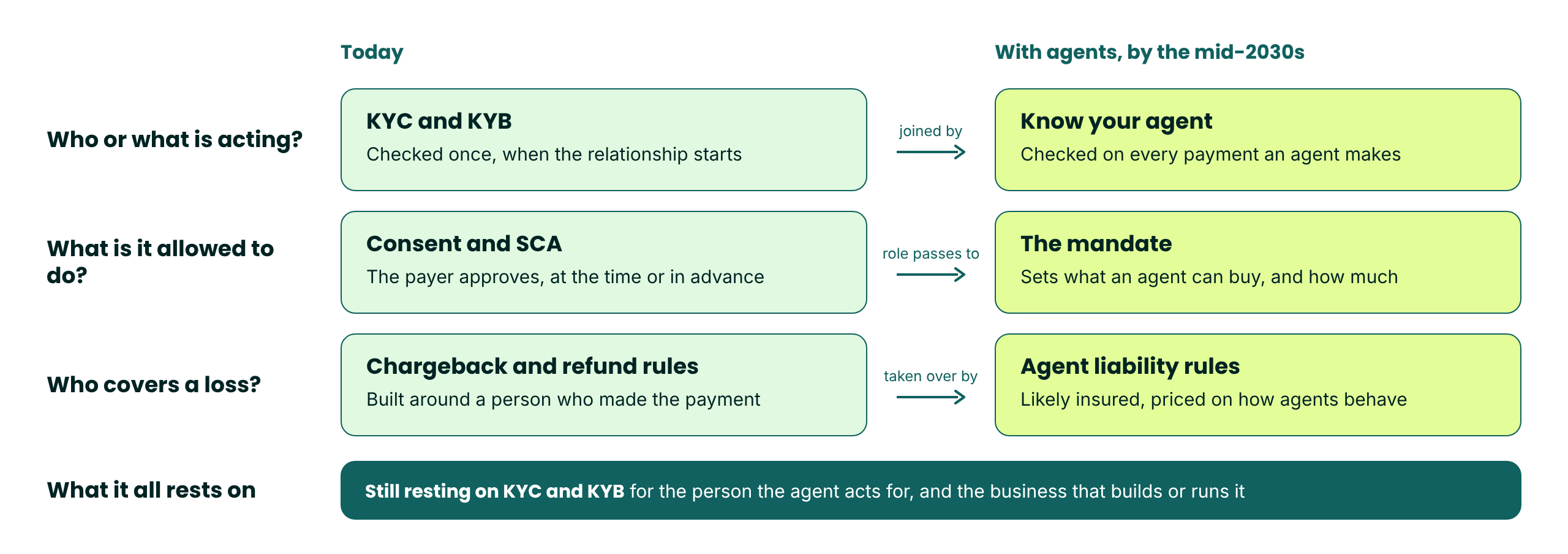
Each layer of that stack has an equivalent today: KYA will sit alongside KYC and know your business (KYB) and answer who or what is acting; the mandate will do the job that consent and strong customer authentication (SCA) do now, setting what the agent is allowed to do; and agent liability rules will take over from chargeback and refund rules in deciding who covers a loss.
KYA also depends on the checks beneath it, because an agent's identity is only as strong as the chain behind it: the person it acts for, checked through KYC, and the business that builds or runs it, checked through KYB. That chain gives regulators a hook they already have, since KYB brings businesses into scope even where the agent itself has no classification.
I'd also expect agent liability to become an insurance product, with the businesses that operate agents carrying cover for misspend, priced on how their agents have behaved, in much the same way a driver's premium reflects their history.
Who should run KYA
That leaves the question of who runs KYA, and my view is that no single rail should. An agent verified once ought to be recognised on cards, account-to-account payments, and digital asset rails alike. Each rail is building its own version today, with the card schemes furthest ahead, but the card schemes can't set the rules for account-to-account or digital asset payments, and the risk is that their version becomes the default simply because it arrived first. Left to the market, I don't expect them to agree one, because no rail has much reason to make it easier for an agent to pay on a competitor's. The more realistic route is the one open banking took, where a regulator requires that an agent verified once is recognised on every rail, building on the KYC and KYB checks that already sit behind it, and that needs regulators to act while there's still time to shape it.
What happens when the agent is the one deceived?
Fraud tends to follow the money, and as more of the money is moved by agents, I'd expect fraudsters to turn their attention from people to the agents acting for them. Many agents will be built quickly, some of them by other agents, and tested far less thoroughly than the banking systems they connect to, and attackers will have agents of their own. In November 2025, Anthropic reported a campaign in which its AI coding tool was used to find security weaknesses and write exploit code with little human involvement, which suggests attacks run largely by AI agents are closer than they might sound.
A deceived agent will also cause problems for consumer protection. Since October 2024, payment providers in the UK have had to reimburse victims of authorised push payment (APP) fraud, up to £85,000 per claim, and the rules are built around a person who was tricked into sending money. When an agent is tricked into sending money instead, the person authorised nothing at the moment of payment, because their consent sits in a mandate they set up weeks or months earlier, and it's not obvious whether that counts as an APP scam, an unauthorised payment, or neither. I'm not aware of anyone having an answer to that yet.
Fraudsters will also find new ways in:
Through the mandate itself: The most valuable trick may be persuading someone to grant a wider mandate in the first place, since setting it up could be the only moment they authenticate.
Through hidden instructions: Instructions hidden in a web page, email, or document an agent reads can redirect it without any person ever seeing them.
Through fake merchants: Fake online shops already catch people out today, and agents may well be better at spotting them. But agents won't need a storefront at all, because they'll read product catalogues and data feeds directly, so the deception will become a convincing catalogue or merchant listing that only has to fool software, not humans.
Through impersonation: A rogue agent can pose as a trusted one, which is exactly what KYA is designed to stop.
KYA only goes so far, though, because confirming that an agent is the one it claims to be doesn't address whether it can be fooled, and a properly verified agent can still be manipulated into a bad payment by any of the other routes above.
Fraud detection will need to change as well, because everyone who monitors transactions, from banks and payment providers to enterprise merchants, spots fraud partly through human behaviour, such as how you type, which device you use, and when you hesitate, and an agent does none of those things. Enterprise merchants are probably the most exposed, since they also use those signals to personalise what each customer sees, so they lose both their risk screening and their personalisation when the buyer is an agent. Stripe has already pointed out that agents can be flagged as fraudulent for exactly that reason. Fraud models will need to learn what normal looks like for an agent, and over time I think payment security will move away from checks built around a person approving each payment and towards continuous checks on the agent, its mandate, and how it behaves, from the moment it's set up to the moment it pays.
If agents end up handling as large a share of everyday payments as I expect, then by the mid-2030s, manipulating an agent will be the most common form of payment fraud in the UK, and the reimbursement rules will have been rewritten around the mandate rather than the moment of payment. Payment fraud, in other words, will look less like a scam phone call and more like Robot Wars, with your money in the arena.
Selling to agents
If the payer isn't at checkout, then what the merchant is really selling to is software that compares, negotiates, and pays on someone's behalf. That has already started, with payment providers such as Stripe now letting merchants send their product catalogues to AI agents through a single feed.
Assuming merchants deploy agents of their own, I think that by the mid-2030s, many everyday prices will be negotiated per transaction between a merchant's agent and a buyer's agent, and marketing aimed at humans will have shrunk accordingly.
Selling to software will have three consequences for payments, the first being that the mandate can't be visible to the seller. If a merchant's agent can see that your agent is allowed to spend up to £200, it will price at £200, so a mandate limit will effectively become a disclosed maximum price. Keeping the mandate private, checked by the bank or another trusted party and never shown to the merchant, will then become as much a consumer protection issue as a data one.
The second is that the cost of paying will become something agents can negotiate. Most people don't choose how to pay on cost and simply use the card they always use, but an agent has no such habit. UK merchants can't surcharge consumers for paying by card, yet an agent can ask for a discount to pay another way ("I'll use pay by bank if you take 1% off"), and so card acceptance costs that people never see would become something agents negotiate over every day. I think that could be the biggest opportunity account-to-account payments will ever get.
The third concerns loyalty, and here I'd go back to my first article, where I argued that cVRP's real value is in recognising returning customers. Agents aren't loyal by nature, but a standing mandate with a merchant is a relationship agreed in advance, on terms you set, with a business you've already decided to trust, and your agent will honour it unless something materially better comes along. In that sense, a single-merchant mandate works as a kind of loyalty contract between the customer and the merchant.
That changes how businesses will need to manage loyalty, because points and offers aimed at a person carry little weight with an agent. The work moves to winning the mandate in the first place, and then keeping its terms good enough, on price, availability, and service, that the agent has no reason to look elsewhere. In effect, the mandate becomes the loyalty programme, and customers will stay with the merchants that run it best.
The two ways this ends
I see two versions of payments without a payer, and I think the next five years will decide which one we get.
In the first, whoever holds the payer's money will also hold the mandate, whether that's a bank, a neobank, or a wallet. The agent's authority will sit with an institution the person already trusts and be checked before any money moves, and the agent will choose the best rail for each payment. It's the ending open banking already points towards, since a cVRP mandate is held by the customer's bank and checked before the payment is made, and in it the provider holding the money will become the place where authority is held and vouched for.
In the second, authority will sit with the company that runs the agent, which could be an AI platform, a device wallet, a payment provider, a digital identity wallet, or one of the card schemes' agent programmes. Agent protocols such as Google's Agent Payments Protocol (AP2) set the format for a mandate, but one of these companies still has to hold it, and the AI platforms seem best placed to do so because they own the relationship with the user. The payment rail would still move the money, but on instructions the AI platform had authorised, and it would be the platform that sets the rules, earns the trust, and is asked to stand behind the payment when things go wrong.
If nothing changes, I expect we'll end up with the second, because the AI platforms are moving faster, they already sit between the person and the purchase, and a bank-held mandate today can't do what an agent will need it to. The first is still within reach, but only if a mandate held where the money sits can cover many merchants, recognise an agent, and carry clear liability rules before agent habits set, which is what my first article asked the UKPI to build into Wave 2 of cVRP. That work is happening now, in scheme rulebooks and regulatory consultations, and most of it will be settled long before 2036.
So the things I'm asking for need to happen within the next few years. Banks, neobanks, and wallet providers should treat mandate management as a product in its own right, and the UKPI should make sure cVRP can carry multi-merchant mandates and agent-initiated payments from the start of Wave 2. Merchants should ask their payment providers how agents will be identified and paid, and those of us shaping the UK's payment rules should design for a payer who isn't there, because within ten years a large share of payments will be made that way.
Sources
Yapily, Money that thinks: cVRP isn't about recurring payments. It's about returning customers.
Yapily, Are stablecoins the payment rail agentic payments have been looking for?
Pay.UK, How Faster Payments work
Competition and Markets Authority, Retail Banking Market Investigation Order 2017, 2 February 2017
Financial Conduct Authority, Open banking takes next step forward with launch of UK Payments Initiative scheme, 2 June 2026
Mastercard, Mastercard unveils Agent Pay, April 2025
Visa, Trusted Agent Protocol, October 2025
HM Treasury, Payments Forward Plan, February 2026
Anthropic, Disrupting the first reported AI-orchestrated cyber espionage campaign, November 2025
Payment Systems Regulator, APP fraud reimbursement protections
Stripe, Introducing the Agentic Commerce Suite: A complete solution for selling on AI agents, December 2025
HM Treasury, Card surcharge ban means no more nasty surprises for shoppers, 13 January 2018
Google Cloud, Announcing Agent Payments Protocol (AP2), September 2025