Open banking has moved from a niche to a mainstream technology. In the UK, more than 15 million people and businesses are using open banking-powered services, equivalent to nearly one in three adults. In the rest of Europe, this number rose to 78 million in 2026. For lenders, there’s a natural fit. Open banking can automate processes, making manual bank statement uploads and static bureau scores a thing of the past.
Lenders building a genuine competitive edge are extending open banking from a one-off application check into a continuous capability that runs from origination through to final collection repayment.
Whether you are a CEO, Head of Product, or Chief Credit Officer at a traditional lender or challenger lending platform, this article walks you through how open banking data (AIS) and payments (PIS) can transform each stage of your lending lifecycle, and what to look for when choosing an open banking provider on which to build this capability.
The hidden costs of inefficient lending processes
Most lending teams know where the operational pressure points are:
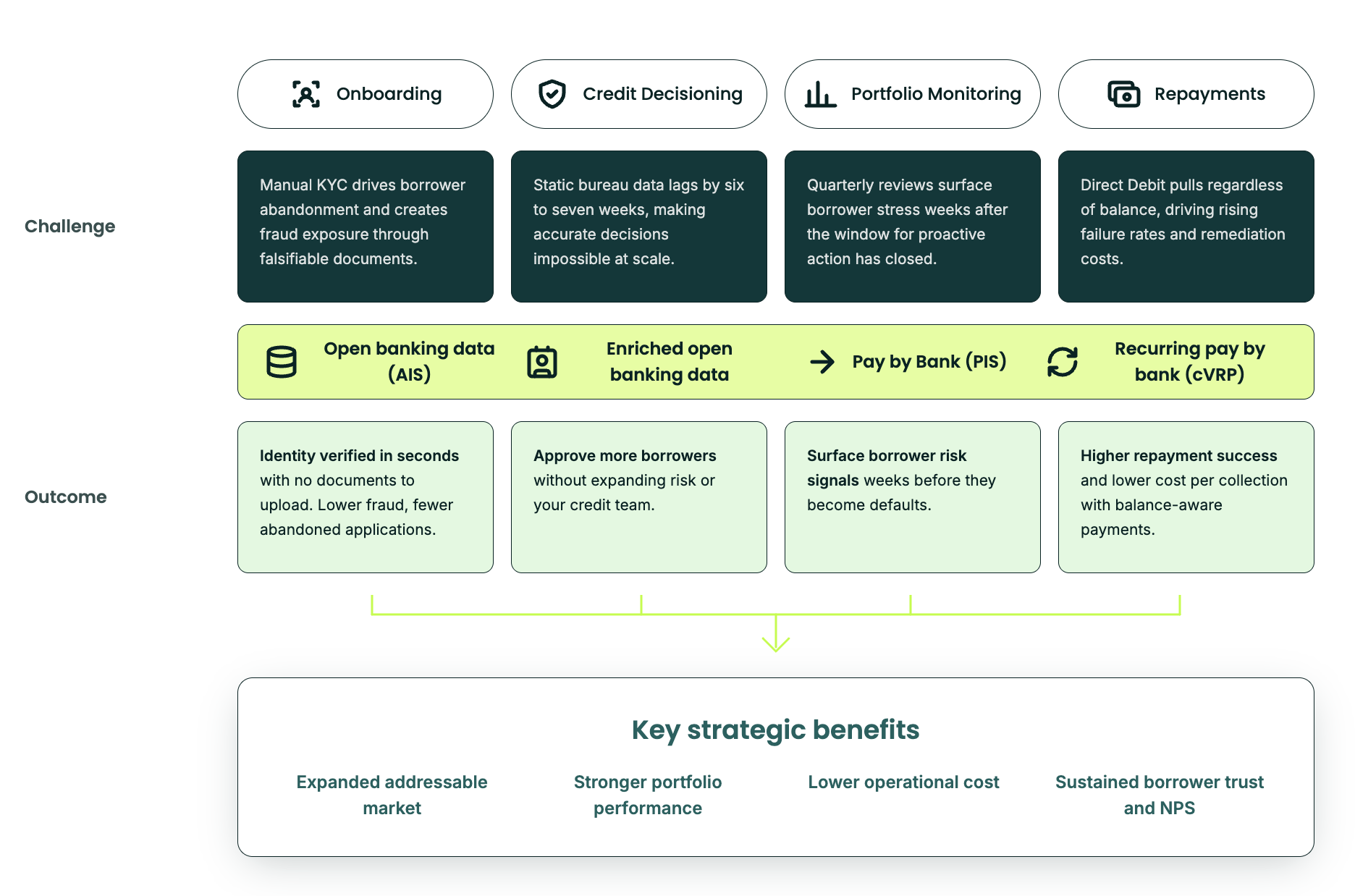
Onboarding: Document uploads, manual identity cross-checks, and KYC reviews slow the journey, leading to borrower abandonment. Fenergo's research shows this problem is getting worse: 70% of financial institutions globally lost clients due to inefficient onboarding in 2025, up from 48% in 2023. Signicat's Battle to Onboard research also finds the average borrower abandons digital onboarding after under 19 minutes, down from 26 minutes in 2020, indicating that consumer tolerance for slow verification is shrinking.
Credit decisioning and affordability: Static bureau scores lag by up to six to seven weeks and manual bank statement reviews make scaling difficult, leaving lenders to make decisions on data that no longer reflects the borrower's current financial situation on a categorisation layer that is rarely accurate enough to drive automated underwriting.
Portfolio monitoring: A credit decision at origination goes out of date immediately, and without continuous visibility, declining revenue, new high-cost debt, and deteriorating cash flow will only surface at the next review cycle, which can be weeks or months away.
Repayments and collections: Direct Debit pulls regardless of account balance, driving failed collections that are only growing more common. ONS data shows the UK total Direct Debit failure rate hit 2.41% in November 2025, up 11% year-on-year and up 15% for the loans category specifically. Most lenders also manage data and payment stacks through separate providers, multiplying complexity across the lifecycle.
Solving any one of these is useful, but solving all four on the same infrastructure layer is where open banking can deliver a significant structural advantage.
How open banking creates a competitive advantage at each stage of the lending lifecycle
 Onboarding: Accelerating origination without the compliance overhead
Many leading lending platforms already know the benefits of using open banking for Identity verification and account ownership. The critical next step is ensuring the quality of execution: confirmation, delivered instantly from direct bank account data through AIS combined with account verification, is the definitive replacement for document-based processes. Even at this early stage, the quality of data and how that data is enriched matters: accurate categorisation distinguishes a borrower's real account activity from the noise of recurring transfers, intercompany movements, or short-term inflows that could misrepresent their financial position downstream.
When onboarding is supported by open banking, the outcomes are measurable:
Faster origination: Verification in seconds rather than days, with a single bank login replacing a queue of uploads.
Lower fraud: Bank-authenticated account ownership replaces document-based proof, removing the opportunity to use fraudulent documents.
Reduced drop-off: Borrowers see one simple step with less effort than manually finding the required documents and uploading them.
Compliant by design: AML and KYC requirements are met without needing to scale headcount and resources.
Credit decisioning and affordability: From point-in-time to continuous monitoring
This is where most lenders are using open banking today, and where the biggest strategic shift can happen.
With the shift towards using AI as the decisioning engine, UK SME lenders are now running fully automated, end-to-end credit decisions on unstructured broker applications, returning answers in minutes rather than days. Accenture's 2026 Banking Technology Trends report highlights that AI-first credit systems can increase automated approvals by roughly 50% and decisioning throughput by 70% to 90%.
That shift means data quality and recentness is more important than ever. An agent that decides in twelve minutes on bureau data lagged by six weeks, filed accounts twelve months out of date, and unverified broker attachments is fast at the front end but slow at the back. The way the data input moves at the same pace as the agent is with real-time, categorised bank transaction data. This is why open banking needs to be the foundation for AI-first lending, rather than an adjacent capability. Without it, the model is simply running on data that no longer reflects the borrower's reality, however sophisticated the decisioning logic is on top.
When credit decisioning is built with open banking data, your addressable market expands without taking on disproportionate risk. The commercial signal is already in the data. For example, openbanking.org reports that lending businesses had 70% fewer defaults than expected when using open banking data in their decisioning. Yapily's enrichment product Data Plus runs on top of its data connections, giving you the level of enrichment and categorisation accuracy you need to provide a more complete picture of the borrower.
The accuracy of that enrichment and categorisation is what separates open banking data that informs a decision from open banking data that drives one. Reliable categorisation needs to distinguish:
Real revenue from affiliate transfers in B2B accounts
Director withdrawals from operating costs in SME accounts
Salary from reimbursements in consumer accounts
Debt repayments and risk indicators from discretionary spend
Without that level of granularity, models work with noisier data than the bureau scores they were meant to replace. With it, you can extend lending to customers typically underserved or marginalised by the bureau score system, opening up new opportunities to diversify and increase revenue.
Portfolio monitoring: Surfacing risk signals before they become defaults
A credit decision at origination is a snapshot of a borrower's financial position on a single day. This includes:
Declining revenue or shifts in income pattern
New high-cost debt appearing on the borrower's account
Sustained drops in cash buffer below historical baselines
Changes in payment behaviour to other creditors
The next stage with risk signals moves beyond this snapshot, recognising that borrowers' financial positions can change from the moment you assess them. Continuous data access is what lets you view that change, enabling you to assess risk more quickly and accurately, and lenders that can continuously monitor risk gain a competitive edge in terms of their default rates.
Reliable data with enrichment and categorisation that enables clean merchant names and processors to be identified at the transaction level is what makes these signals usable.
For B2B portfolios, the depth matters even more. Reconstructing a business borrower's real revenue sources, HMRC obligations, payroll cycle, and operating costs from live transaction data gives you a view that filed accounts from twelve months ago cannot match.
Repayments and collections: Lower cost, higher conversion
Most lenders manage data access and collections through separate providers, which adds complexity and increased resources. A single integration covering data and payments removes that fragmentation, so your operations work from one source of truth.
In the face of rising Direct Debit failures due to its opaque and inflexible design, lenders and their borrowers need an alternative that benefits them both. In the UK, commercial Variable Recurring Payments (cVRP) offers a direct alternative to outdated Direct Debit:
Pre-pull balance check: cVRP only collects when funds are available, removing the main cause of Direct Debit failures.
Lower costs: Account-to-account collection rivals direct debit on lower fees (under £100) and beats it on collections above it, making significant savings.
Borrower-controlled limits: Predefine parameters at set up so borrowers can feel in control of their outgoings, helping to build trust and certainty.
Instant cancellation: Borrowers retain control through their bank app, reducing dispute friction and accidental overpayments.
cVRP Wave 1 launches in 2026 for regulated financial services, utilities, charities, and government, with wider lending use cases following in Wave 2. Although the rollout is UK-only, it is being closely watched across Europe as a template for how recurring open banking payments can scale beyond sweeping use cases. Lenders who connect data and collections on the same foundation now will be best placed to extend into cVRP in the UK, and into equivalent rails as they emerge in other markets.
Why Yapily should power your lending lifecycle
Yapily provides the data, payments, and coverage infrastructure that lenders need to extend open banking across the full lifecycle, on a single foundation.
Data depth and breadth built for lenders
99.5% UK business account coverage, with strong consumer and business coverage across the UK, Germany, and France, so your decisioning works the same whether your borrower banks with NatWest, Deutsche Bank, or BNP Paribas.
Data Plus enrichment and categorisation: up to 94% accuracy on consumer transactions and 83% on business, with B2B-specific distinction between real revenue, HMRC obligations, director withdrawals, and operating costs.
Broad category coverage: 190+ categories across consumer/business and incoming/outgoing transactions.
Runs on your existing AIS connections, so you can lift categorisation accuracy without re-platforming or re-tendering your AIS contract.
Payments built for the next phase of the lending market
Founding member and shareholder of UK Payments Initiator (UKPI), with direct input into cVRP scheme developments and Wave 2 planning.
Europe's first commercial VRP pilot for e-commerce, launched in August 2022.
97% payment success rate on sweeping use cases and a 90% mandate completion rate.
Trusted at scale
2,000+ banks across 19 countries through a single integration covering both AIS and PIS.
721 million successful API calls in 2025, with 99.98% weighted availability.
Trusted by Google and Adyen for data services in major European markets, and used by lenders including Yonder, Lovey, Doovey, and Allica Bank.
Build your edge across the full lending lifecycle
The advantage that open banking can bring to lending now sits with the providers who treat it as full-lifecycle infrastructure rather than a single application-stage tool. Better onboarding, more accurate continuous decisioning, earlier risk signals, and lower-cost repayment collections should all run on the same foundation, and that foundation gets stronger every quarter as cVRP scales.
Book a call with one of our open banking experts to discuss how this applies to your lending platform.