Last updated: 18 August 2026
AI shopping agents are already searching, comparing, and buying on people's behalf, but they are only getting started. The same agent that can reorder your regular groceries in the background could, just as easily, spend an evening building the perfect long weekend away, comparing flights, checking dates against a dozen hotels, and pulling together an itinerary that would otherwise take hours of effort to research and create manually. Between those two use cases sits a wide-open space for what shopping could become once an agent can act on your behalf, and it’s just the start of one of the most exciting shifts in e-commerce.
Agentic commerce will be arriving at the checkout quicker than many realise. And, many consumers are still wary of how much they are willing to let an agent do on their behalf. That decision, more than any technical milestone, will be a crucial barometer for the pace of adoption. Because adoption is also what drives the next round of investment and development, the trust gap is not something the industry can leave until later. This article looks at that gap and how Yugo, a Yapily customer, is bridging it through its innovative collaboration with Urbo to build a working prototype.
“At Yugo, we’re building the infrastructure that connects AI agents with businesses, enabling them to interact, decide, and transact securely. We believe agentic commerce creates value for both sides: faster, more personalised experiences for consumers and greater operational efficiency for merchants through end-to-end automation.”
Georgi Shulev, Co-founder, Yugo
The trust gap
Research from companies closest to this transition raises the question of how to build trust in agentic commerce. Checkout.com's Agentic Commerce 2026 report found that AI agents play a meaningful role in only 3% of online transactions today, while 85% of merchants expect agentic commerce to reach at least 10% of their online sales within two years. There is clear interest among merchants in what agents can do, but there’s a lot of uncertainty alongside it. Nearly a quarter of consumers say they would not hand a purchase to an agent at all, and Worldpay's Agentic Commerce Report found that only around 6% are comfortable letting an agent complete an end-to-end purchase on its own, with comfort dropping as the value of the purchase increases.
Handing a purchase to an agent means letting software act with your money, share your details, and commit you to something. But consumers' main concerns are what happens if the agent gets it wrong, buys the wrong thing, spends more than expected, or shares more than they intended, and whether they can step in or undo it.
That trust element is a typical response to a new way to pay or buy, and it’s not the first time the industry has needed to address it. The speed at which this gap can be bridged depends on designing agentic commerce so that consumers feel in control of what an agent does for them.
How Yugo is bridging the gap
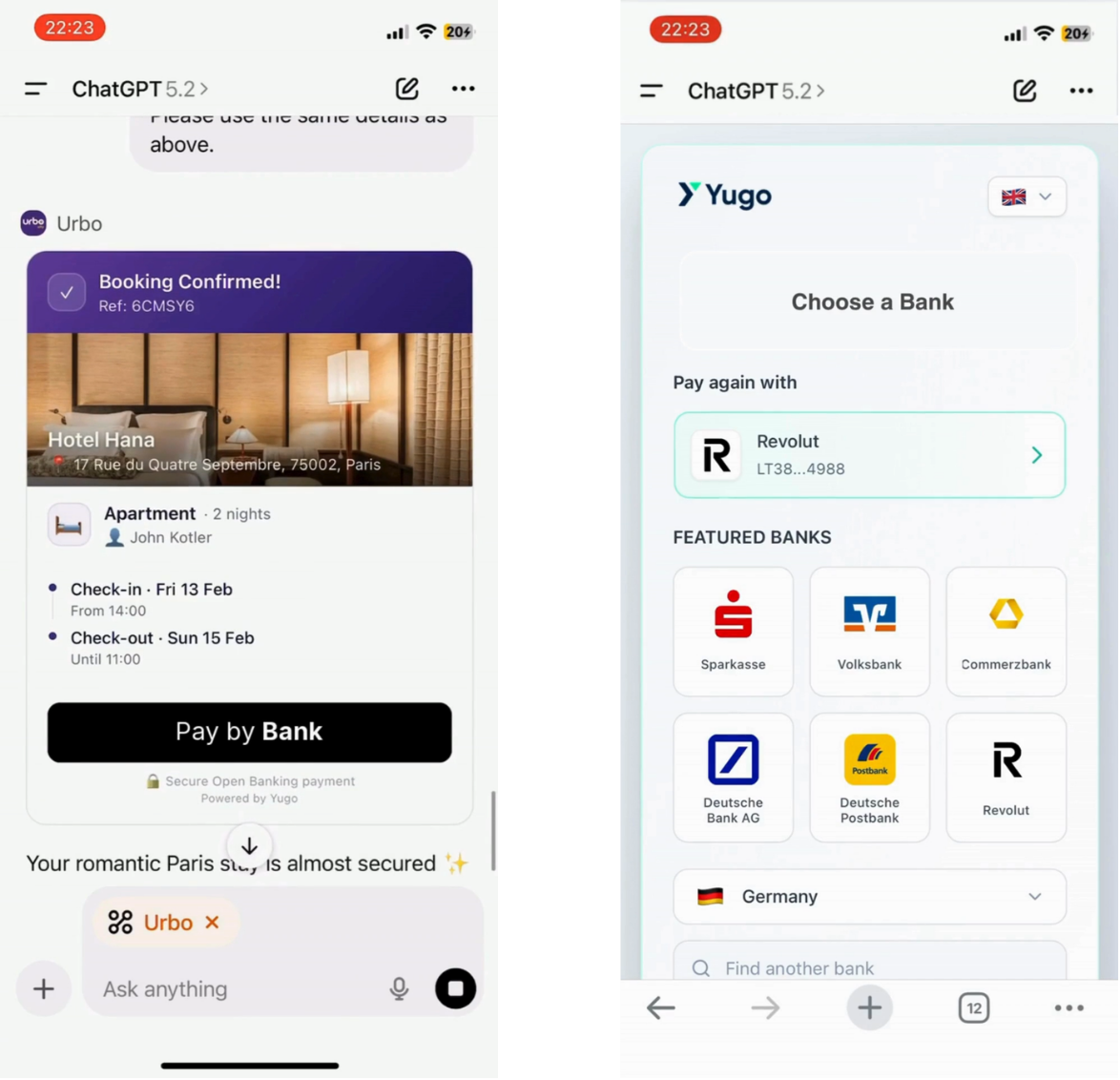
While the industry works towards a longer-term answer, Yugo has built something that addresses the trust problem now. Its prototype, built with Urbo, lets an agent handle the searching and legwork, while keeping the consumer in charge of the decisions that matter. It runs inside the AI assistants consumers already use, and handles a request from the first search through to a confirmed purchase.
Here is how a purchase works in the prototype:
The consumer makes a request in plain language, and the agent searches and assembles the options, whether that is flights, tickets, a full itinerary, or a simple food shop.
The consumer reviews the options and confirms the cart. Importantly, nothing is bought and paid for until they do.
Before any personal information is shared, the consumer sees exactly what will be shared and gives their consent.
Payment is made through a trusted Pay by Bank link, which is authorised by the consumer in their own banking app.
Once payment clears, the booking is confirmed, and the consumer gets their confirmation straight away.
The result is a process that uses AI to do the hard work of searching and assembling complex purchases for you, while leaving the decisions that carry risk with the person making them.
“Working with URBO, we’re putting that vision into practice by developing an agentic commerce solution built around one simple principle: AI should be able to transact independently, but always within clear security, compliance, and governance boundaries.”
Georgi Shulev, Co-founder, Yugo
Trust at the point of payment
Control is where trust is built, and the payment is the moment where trust is most important. A great deal of work across the industry is going into letting agents pay entirely on their own, using delegated authority and stored credentials. As research from Checkout.com and Worldpay has shown, the demand for that looks limited for now, and consumer trust in it is low. Yugo's answer is to keep the consumer in the loop at the point of payment, with a trusted Pay by Bank link, rather than handing the payment to the AI agent. This means the most sensitive step remains familiar, with Pay by Bank sending them to their trusted banking app instead of resting on credentials held by an agent they’re still unsure about.
That decision helps with a problem the industry has not yet resolved: who is accountable when an agent-led purchase goes wrong? Checkout.com found that merchants most often expect the payment provider to carry the cost of a disputed purchase, while consumers most often look to the agent platform, and that 76% of merchants think payment providers will be central to making agentic commerce safe enough to scale. With responsibility that unsettled, the report concludes that the ecosystem needs clear proof of consent and a record of what was agreed.
Open banking answers those needs directly. With Pay by Bank, the consumer approves the payment inside their own banking app, using strong customer authentication under PSD2, and the agent never sees or stores their card details. Each payment leaves an authenticated record of who approved it and what they approved, which is close to the proof of consent the reports describe as missing. If a purchase is later questioned, that record gives everyone involved something concrete to point to.
Set against a card payment, it is a stronger fit for agentic commerce on several counts:
Trust element | Card checkout | Pay by Bank |
Steps to complete payment | Around six: card number, expiry, CVV, name and billing, a 3D Secure challenge, then confirm | Around two: choose the bank, then approve with biometrics in the banking app |
Authentication | A 3D Secure step-up, such as an OTP or in-app challenge, which is a recognised drag on conversion | Strong customer authentication in the bank’s own app, with no redirect and no re-entry of details |
Agent readiness | The agent must handle card credentials and usually hits a step-up that needs a human, breaking the automation | A single approval against a pre-authorised consent, within the customer’s limits, lets the agent complete the flow |
Card details | Shared with, and often stored by, the merchant or agent | Never shared with the agent |
Evidence of consent | Harder to tie to a clear, authenticated approval | An authenticated record of who approved the payment and what they approved |
Chargebacks | Exposed, and funds can be reversed | Not subject to card-scheme chargeback rules. |
This is where Yugo’s research puts the up to three times faster figure: on a like-for-like, agent-initiated checkout, a card flow of around six steps against roughly two for Pay by Bank. Every extra step is another point where an agent-led payment can stall or drop out. The more trusted option is also the quicker one, which makes Pay by Bank a natural fit for early-stage agentic commerce flows. This is the part Yapily provides for Yugo: the open banking connectivity behind Pay by Bank.
"The challenge of agentic commerce is delegation: letting an agent transact on your behalf without giving it credentials it can reuse. Open banking supports exactly that: the customer approves each payment directly in their banking app. The agent never holds card details or any standing authority to move money, and every transaction leaves an auditable record of exactly what was authorised. The agent can initiate a payment, but only the customer can authorise it, and the bank enforces that separation. That is the right trust model for what Yugo is building with Urbo, and it is why Yapily is providing the Open Banking infrastructure behind it."
Roland Selmer, Chief Product Officer, Yapily
Building trust in stages
Trust does not appear overnight. It builds as consumers try something, see it work, and grow comfortable enough to do more. That is why adoption and trust move together: each round of use makes the next one easier, and the technology develops in step with the confidence consumers have in it. For agentic commerce, building trust and building adoption are the same job.
Checkout.com’s data already shows consumer appetite for agentic commerce is strongest for everyday, lower-risk purchases like groceries and household essentials, and weakest for the decisions that feel consequential. Merchants expect the opposite, assuming delegation will begin with complex, higher-value categories such as travel. It is the consumers' worth following here, because trust is earned on the small things first and extended to the larger ones over time.
A good example of when payments has seen this before, and in some regions is still going through, is contactless payments. When contactless cards arrived in the UK, they came with a low spending limit and high public wariness. The limit rose in steps over the years that followed, each increase tracking better fraud controls and driving growing confidence, until tapping to pay became second nature. A new way to pay earns a wider remit as its safeguards prove themselves.
Agentic commerce is at the early, low-limit stage of that same curve. The sensible path is to build flows consumers can trust today, with visible controls and a payment method they already use and trust, and to widen what agents handle as confidence grows. That is what Yugo is building: agentic convenience with guardrails, the equivalent of contactless while the limit is still low. The wider market is moving in the same direction, from Santander and Mastercard completing Europe's first live payment made by an AI agent in a controlled environment in March 2026, to the shift from PSD2 to PSD3, which may in time let trusted agents make repeat purchases without a fresh approval each time.
We’re at the start of an exciting payments journey
The companies building agentic commerce keep reaching the same conclusion: how far it goes will depend on trust. That gives an advantage to anyone who treats trust as something to build into the product from the start. Yugo is doing just that by keeping the consumer in control of the decisions that matter and settling payments through open banking.
This version is still a working prototype, with a live product to come, so this is an early look. But it shows how agentic commerce that consumers are actually willing to use can be made possible. As more buying moves into AI assistants, a payment the consumer recognises and approves themselves, built on open banking, is one of the clearest ways to carry trust into the transaction.